
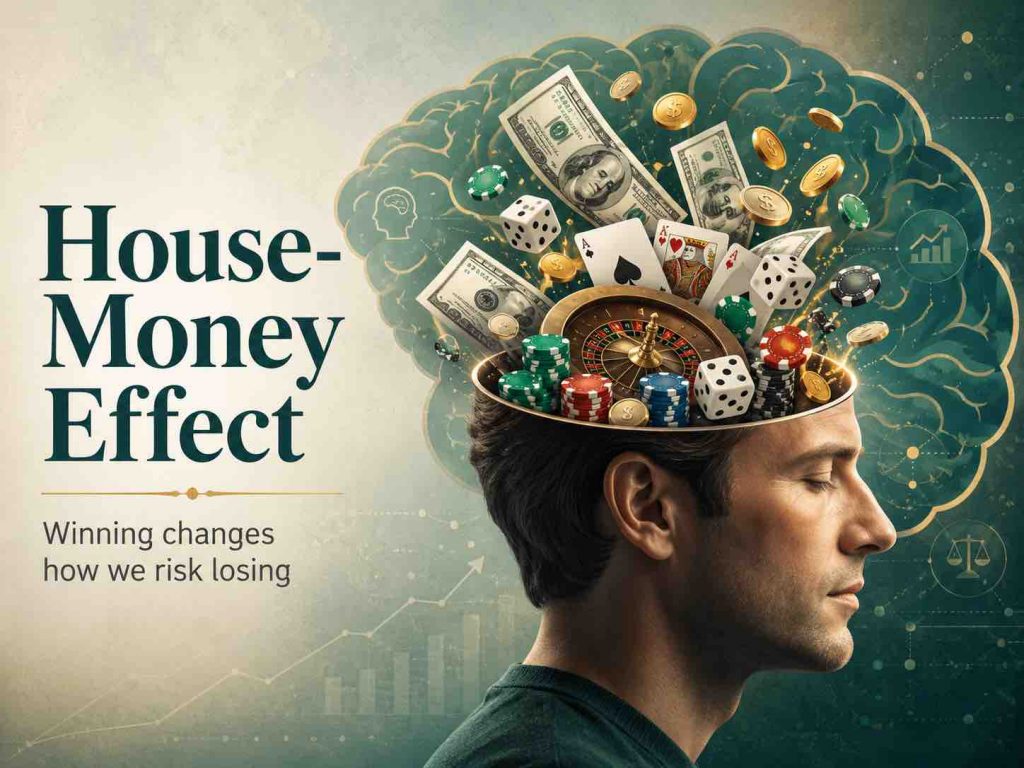
Why Do You Still Lose After Winning?

The "House Money" Trap Explained
It’s Saturday afternoon. You bet on Arsenal to win at 2.10 odds, and they win 3-0. Your forty pounds becomes eighty-four. Feels good.
 
An hour later, you check the evening games. There’s a bet you usually avoid, Brighton playing away. The odds look good, but you know their away record isn’t great. You pause for a moment, then think, “It’s just the profit.” Then, you click it.
 
Now the real risk isn’t Brighton losing anymore, but your earlier win quietly changed your usual rules.
 
The “house money” feeling happens when your winnings stop feeling like real money, making your next decision seem less important.
 
This is one of the subtle ways discipline fades. There’s no big meltdown or obvious mistake. Instead, your mind quietly gives you permission after a win, and your standards begin to change.
 
So what exactly happened in that moment between the Arsenal win and the Brighton bet?

What the "House Money" Effect Actually Is

Most people create two invisible accounts in their head: “my money” and “winnings.” Although, It’s the same money in the same account, but the way you label it changes everything.
 
If you put in £100 and it grows to £180, you have £180. But your mind often splits it into “my hundred” and “the eighty I won.” That extra money feels different, lighter, less real. It’s like using casino chips you didn’t bring in, so losing them doesn’t feel the same.
This isn’t unique to betting. Investors do it with stock gains. People do it with tax refunds or bonus payments. The pattern is the same: when money arrives unexpectedly or through a win, it gets mentally filed under a different label. And that label changes how carefully you treat it.
 
But here’s the simple truth: if you can spend it, it’s real money. Telling yourself a story about where it came from doesn’t change the risk. A £20 bet costs £20, no matter if it came from your paycheck or a recent win. Still, it often doesn’t feel that way.

You don’t choose to split your money this way, it just happens. You don’t decide to treat winnings differently, you simply do. The trap is thinking your feelings match reality, but they don’t.

Think back to the Brighton bet. Your balance was £84, but your mind saw it as “my £40” and “the £44 I won.” It’s the same money, but it feels different. That mental split made your next decision feel easier.
 
Which brings us to the real question: why did “just the profit” feel like permission?

Why Wins Make Rules Feel Negotiable

Winning does something immediate to your nervous system. There’s a little spike of relief, a bit of excitement, maybe some validation that you “read it right.” That feeling is real. The problem is what it does to friction.

The feeling after a win is simple. It gives you a boost and lowers your resistance. An idea you might have ignored ten minutes ago now feels easier to justify. It’s not that the bet got better, your mood did. After Arsenal won, the Brighton bet didn’t change. Your away-form concerns didn’t disappear. But the decision felt easier because the win lowered your guard.
 

Then comes confidence creep. A win feels like proof, or at least a hint, that you know what you’re doing. You start to think, “Maybe I am seeing this clearly.” The line between skill and luck gets blurry. One result can’t prove you have an edge, but your mind doesn’t always wait for more evidence. After one win, your doubts fade a little.

The hidden danger, the one that really matters, is this: you don’t decide to be reckless. You just bend one rule “this time.”

You tell yourself it’s reasonable. The stake drifts from £10 to £15. You add one more bet to the slip. You skip the usual pause. It doesn’t feel like a shift because the story makes sense in the moment: “I’m up. I can afford it. Just this once.”

But saying “just this once” is how your standards shift. Rules don’t break all at once. They change slowly, one small exception at a time, until the exception becomes your new normal.
 
The Brighton bet wasn’t reckless by itself. It became reckless because it only happened after Arsenal’s win. That’s how the pattern works. Once you notice it, you start to hear it in your own thinking.

The Baseline Shift (What It Looks Like in Real Life)

If you’ve felt this, you’ll recognise the phrases. They’re quiet. They feel reasonable in the moment. But they’re all doing the same job: making the next decision feel less serious.

It’s just the profit.” As if profit is play money. As if the label makes the risk smaller.
 
“One more won’t hurt.” Which is often true for one bet. But one bet after a win tends to lead to two. Then three. Then “let me just check the late kick-off.”
 
I’m on a roll.” Translation: I won one, so I’ll win the next one. That’s not how probability works, but it’s how momentum feels.
 
“Let me press it once.” A slightly bigger stake. Just a test. Just because you can.
 
Your behavior changes along with your words. You don’t suddenly decide to act differently. Instead, you might notice a day or a week later that you’ve started doing things a bit differently.
  • Slightly bigger stakes than usual.
  • Slightly more bets than you planned.
  • Slightly less patience before pulling the trigger.
  • Slightly more urgency to “stay involved.”
The real change isn’t just one bet. It’s your usual standards slowly shifting. What once felt like “pushing it” now seems normal. What once needed a strong reason now only needs a small excuse.
 
You still feel like the same person. Your story about yourself hasn’t changed. But your decision-making has. The gap between how disciplined you think you are and how disciplined you really are is where the cost shows up.
 
None of this means you’ve made a mistake. But it’s important to understand what the house money feeling is, and what it isn’t.

What This Does NOT Mean + A Calm 30-Second Reset

First, the corrections.

A win does not mean you found an edge. One result tells you almost nothing. Uncertainty didn’t disappear because you got Arsenal right.
 
“Winnings” are not separate from your money. The label is invented. The cash is the same whether it came from Saturday or six months ago.
 
Confidence is not evidence that uncertainty disappeared. Feeling certain and being certain are not the same thing. The former is just a mood.
 
Feeling “hot” is a feeling, not proof. Variance has runs. Runs feel like patterns. Patterns feel like control. None of that makes the next outcome more predictable.
 
If you catch yourself in the house money zone, where a win has made the next decision feel lighter, it can help to pause for thirty seconds and ask three questions. Not rules. Just questions.
  1. Would I do this if I hadn’t just won? If the answer is no, that’s useful information. The Brighton bet probably doesn’t happen if Arsenal lost.
  2. Am I treating this like it’s not real money? If you’re using phrases like “just the profit” or “house money,” you probably are.
  3. Am I bending a rule I usually respect? Stake size. Number of bets. Time limits. If the answer is yes, the question is: why now?
These questions aren’t meant to stop you. They’re meant to add back the hesitation that the win took away. The goal is to see the moment clearly.

If it still feels right after the pause, fine. But if the only reason it feels right is the win, that’s worth noticing.
 
Reset sentence: “A win doesn’t change uncertainty. I’m not more certain, just more excited.”
Excitement is fine. Just don’t let it rewrite the rules.

The Win That Changes You

Wins can make you lose discipline faster than losses. Losses hurt, so you react. Wins feel good, so they often go unnoticed. That’s the trap. The house money effect isn’t just about one bad bet. It’s about quietly giving yourself permission, the moment when “my rules” become “my rules, except.” Once that exception feels normal, your standards have shifted. And once that happens, the next change is even easier.
 
The goal isn’t to avoid winning. It’s to notice when a win changes your thinking, and to pause before your next decision creates a new rule you didn’t intend. Calmer. Clearer. Less urgency. That’s the goal.
Educational purposes only. No picks, tips, or guarantees. Gambling involves risk—only participate legally and responsibly, and only what you can afford to lose.
Scroll to Top