
Sports betting is widespread in many countries. In the United States alone, studies suggest that about 60 million adults engage in sports betting in some capacity, according to estimates for 2025. That tells us just how popular sportsbetting is, even in a single country.
But what exactly are people betting on? They bet on outcomes, and odds are the terms attached to those outcomes. Here’s a quick and simple definition for odds: They are a price tag on uncertainty provided by sportsbooks. Odds exist in betting markets because the uncertainty of match outcomes needs to be quantified, and they are expressed as prices. Odds are not “that is a sure win or no way they lose” stories, nor a promise of what will happen, but how sportsbooks price the likelihood of something happening in a match.
The purpose of this article is simple: not to make you “better at betting,” but to explain how odds work and reveal the top 3 common misunderstandings.
Related Articles:
How Odds Work?
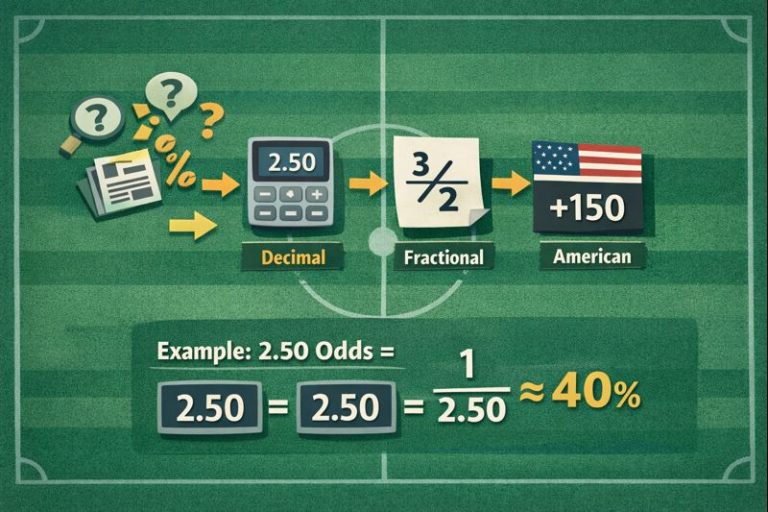
Odds can be strangely cold. They don’t care if a match outcome is “deserved,” like soccer fans always say: “Arsenal lost last week and the manager is under pressure, now this game they have to win.” Odds work differently. They are not meant to be a sentence but a price, a set of terms. It’s the sportsbook’s way of saying: “This outcome is uncertain, and here’s how that uncertainty is being valued right now.” Usually, depending on where you are or which sportsbook you are looking at, odds can be displayed in 3 different formats with the same interchangeable idea:
- Decimal odds (common internationally)
- Fractional odds (UK/IE)
- American odds (US)
Many sportsbooks let you view odds in different formats, but the underlying price is the same.
For example:
- Decimal: 2.50
- Fractional: 3/2
- American: +150
Those three refer to the same underlying price, just displayed differently.
As mentioned above, odds reflect how sportsbooks price the likelihood of an event, which is an implied probability. Let’s say it’s 2.50 for Team A to win, and a common way to interpret decimal odds is to translate them into a rough implied chance:
Implied probability ≈ 1 / decimal odds, so for 2.50 will be 1 / 2.50 = 0.40 → about 40%
This implies roughly a 40% chance of the outcome, in this example, Team A winning. That’s a translation of the number, not a promise or a ‘true’ probability.
So, if odds are just possibilities, why do some people still treat them like some kind of secret messages?
The top 3 common misunderstandings?
Odds can be confusing because people sometimes mistake them for predictions and assign meaning to their changes.
Misunderstanding 1: “Odds are expert predictions.”
Well, odds are not a clean verdict from “the smart people” or sports experts, even if the number looks official and feels like authority, odds are still not a guarantee. They are not a single person’s opinion but a market price shaped by a lot of information. They reflect public behavior and risk balancing. What you see is and always will be pricing of uncertainty, simply because football is never a sport that rewards certainty. Sometimes you will lose even when a price looks “reasonable.”
Misunderstanding 2: “If odds move, someone must know something.”
If odds moved or changed since you saw them last time, does the sportsbook know something that you don’t, so you will lose no matter what? The answer is no. Odds move as the kickoff approaches, and most movement is much less dramatic than people imagine, often reflecting the boring reality of information spreading, people reacting, and the market rebalancing.
So what actually moves odds before kickoff?
Below are some everyday reasons:
- Team news, like injuries, selection, and late changes.
- Schedule context: fatigue, travel, rotation, and conditions like weather or pitch.
- Public behavior: overreaction, narratives, momentum, etc/
There is the part most fans don’t instinctively think about: Sportsbooks are also managing exposure. If too much money piles up on one side, the price can move to keep the bet money balanced. It’s simply risk management for a sportsbook, so they don’t lose money by providing such a service.
And most importantly, odds movement does not automatically mean the price is now “more accurate.” It often just means the market is updating its terms based on what it’s seeing. A shifting number isn’t telling you that certainty increased. It’s just telling you that the market or sportsbook changed its price.
Misunderstanding 3: “Suspicious odds = the match is fixed”
If you see suspicious odds and, worse, the team performs weirdly in a game, for example, using no defensive tactic or maybe even scoring an own goal, people often cry “fixed match.”
First of all, match-fixing does exist, but it’s more often associated with criminal networks and vulnerable competitions, such as lower-profile leagues, underregulated markets, and illegal betting ecosystems. In a mature and regulated market, the reality is much more boring: Sportsbooks don’t need match fixing to profit. Given that fixing is illegal, high-risk, and attracts investigations and reputational damage. Guess what? Odds already reflect sportsbooks’ margins, and operators manage risk so they can stay profitable over time, which alone will make them a lot of money, so there is really no reason for them to fix a match with all the risks involved.
With all said, How Can Odds Be Better Used?
When people bet on games, especially for casual bettors, they often think in stories, not numbers. For example, “Man City always wins at home,” or “No way Arsenal will lose this one.” That’s normal, and honestly, it’s part of what makes football fun. Although the problem starts when you turn the story into some kind of certainty, not just “I think this will happen,” but “I know this will happen.” You’ve probably argued about a game with friends before, right?
Now Odds can get in the way of that certainty feeling, as odds aren’t telling a story but showing a price. And that price can be translated in to only probablities, it’s basically the sportsbook saying, “well, whatever you say, this is still uncertain”, which is why odds can sometimes feel personal when the price doesn’t match your gut feeling (for example, the price translates to a low implied chance, even though your gut feels it’s ‘certain’). It can feel like someone is calling you wrong.
But for most of the time, it’s just not that complicated; it’s your brain that wants a stable story, whereas odds refuse to pretend the game is stable and certain. These are two very different ways to anticipate an outcome. As simple as that.
A healthier way to read odds is to treat them as a realitycheck, not a control button. They are a quick label for the uncertainty of the outcome. Lower odds usually mean the sportsbook sees it as more likely. Conversely, higher odds mean less likely. That’s it.
We all know the football game result is uncertain. One red card, one weird moment, a mistake can shift the outcome significantly. That’s why the healthiest way to think about results is simply that a win means one uncertain outcome happened, and a loss means it didn’t happen, although it doesn’t mean it was “impossible.”
So the best use of odds is to stay honest about uncertainty. Most importantly, odds help you stop treating your story like a fact. They help you watch the game without thinking, “This is definitely happening.” Instead, you stay calmer and more realistic, which is usually needed the most around football predictions.”
Related Articles: The Real Risk of Betting: When “Fun” Turns Into Loss of Control
FAQ
Do odds tell you who will win?
No. Odds are a price label on uncertainty, not a guarantee about the final score. They can reflect expectations, but football constantly punishes certainty.
Why do odds change when nothing obvious happens?
Because information can spread quietly, and markets rebalance. Not all movement is dramatic, a lot of it is normal updating.
Are low odds “safer”?
Low odds usually mean “priced as more likely,” not “guaranteed.” In football, many “likely” outcomes fail often.
Do odds include margin?
Often, yes. Odds are not perfectly neutral probability statements; they are priced products in a market, and margin is part of the sportsbook’s pricing.
Can odds be wrong?
Sportsbooks can be biased or imperfect, but the bigger risk is thinking any number can remove football’s uncertainty.
Are the odds the same everywhere? Why do they differ?
They can differ across markets, customer behavior, risk balancing, and reactions to information. Some sportsbooks, they offer higher odds to attract players as a marketing initiative.