
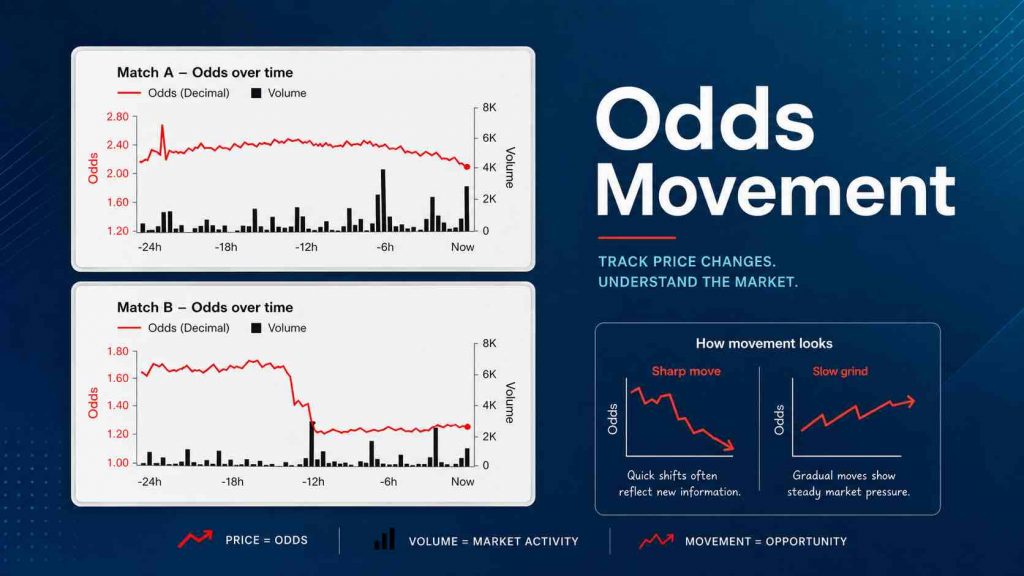
What odds are actually reflecting
A few mental habits can come into play.
Firstly, Confirmation Bias: You already believe City will win, and you see City’s odds getting shorter, which your brain takes as proof, even though the change might be caused by something unrelated to the match. To the contrary, there is Loss aversion: if the odds get longer on the team you were thinking about. Suddenly, you might feel pressure and think, “I’m missing out.”
Lastly, the illusion of inside information: When odds move sharply, sometimes you would assume someone knows something you don’t. Well, sometimes that might be true, but more often, it’s just market noise, money moving for reasons that have nothing to do with the actual match.
So what actually moves the odds line
Driver 1: New information comes into the market
Driver 2: Money flow changes
The goal isn’t perfect balance. It’s about limiting risk from one result that could cost them a lot. More money on one side might be because:
Related reading: Sports Betting 101: How Sportsbooks Work
Driver 3: Sportsbook risk controls
Driver 4: Market alignment between sportsbooks
Driver 5: Different bettors react at different speeds
Live betting: how in-play odds move differently
What odds movement does NOT mean
Now we’ve outlined what changes the odds. Let’s be direct about what movement doesn’t tell you:
- It doesn’t mean the result is decided. Odds can shorten dramatically, and the favorite can still lose. Movement updates probability estimates. It doesn’t remove uncertainty.
- It doesn’t mean the outcome is guaranteed. “More likely” isn’t “certain.” A team at 1.30 is favored, but roughly 1 in 4 times (simplifying the implied probability), and they don’t win. That’s not rare.
- It does not mean you must act right now. Urgency is a feeling, not evidence. The line moving doesn’t mean opportunity is vanishing. It means the market is adjusting.
- It does not automatically prove your original read was wrong. If you thought Newcastle had a chance and the odds drift further against them, that could be noise. It could be an overreaction. Markets aren’t perfect. Movement can be driven by crowd psychology just as easily as by genuine insight.
- It doesn’t mean the match is manipulated. Sharp movements sometimes trigger suspicion. In rare cases, unusual patterns do warrant investigation by regulators. But the vast majority of line movement is just ordinary market mechanics: information, money flow, and risk adjustment happening in real time.
Final thoughts
Continue Reading: