
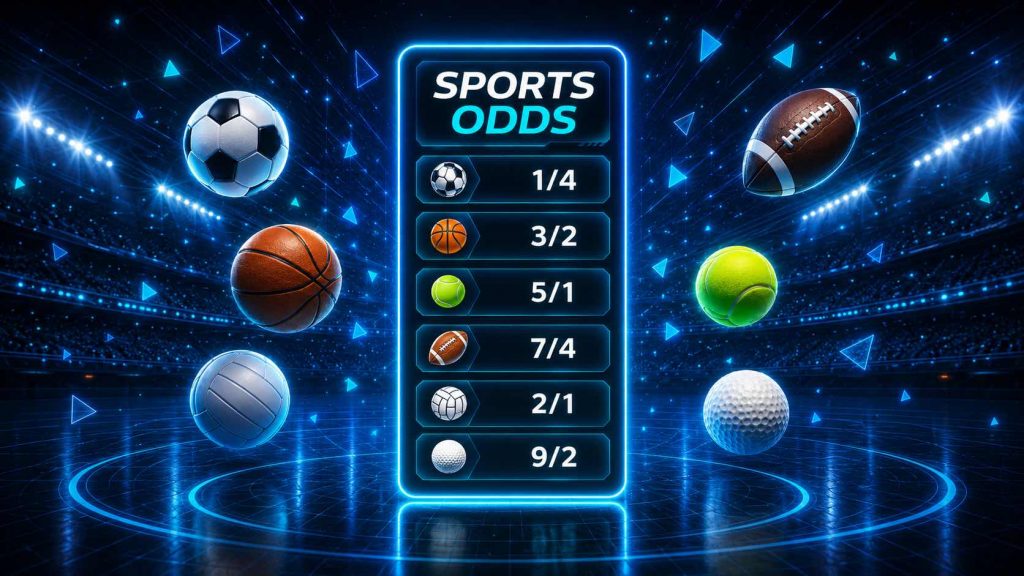
If you check the same match on different platforms, you might notice something strange. One odds might show 1.85, another 4/5, and a third -125. It’s the same game at the same time, just three different ways to show the same price(odds).
Although that difference in format is only the beginning. What really matters is that none of these numbers are predictions. They are more like a quote, a price offered for a certain outcome in a certain situation. The number you see is a kind of language, and like any language, it can be misunderstood.
Why odds matter at all
Let’s start with the sportsbook side. Without odds, a sportsbook couldn’t turn uncertain outcomes into something it can manage. Every match, market, and result needs a price that can be shown, updated, and compared across hundreds of events at once. Odds give the sportsbook a shared system for this. They also usually include a margin in the price, which acts as a buffer to help the platform manage its risk. You can read more about this in Sports Betting 101: How Sportsbooks Work.
Now, from the player’s perspective. Without odds, you’d be relying mostly on gut feeling. You might think one team will win, but there’s no number to challenge your instinct or compare your opinion to. Often, people fill that gap with group chat opinions, stories, or the general mood, but these don’t show what the market is actually pricing. Odds, even with their flaws, give you a reference point. They’re something to hold onto, not a final answer.
Where the price came from
Imagine this a few hundred years ago. Someone wants to bet on a horse race. A man nearby says, put in 100, and if your horse wins, I’ll give you back 150. That was the whole transaction: no app, no screen, just one person making a verbal offer to another.
But that man wasn’t being generous. He also took bets on the other horses in the same race, changing what he’d pay each person based on his own view of the field. He made sure that, no matter what happened, he wouldn’t owe more than he collected. His advantage came from his judgment and from keeping just enough margin to stay ahead over time.
That man is, more or less, where the modern sportsbook begins.
The core logic stayed the same, but the scale, tools, and format changed. As betting became more professional and common, informal verbal offers were replaced by standard written prices. Different regions developed their own styles: fractions in the UK, decimals in much of Europe, and the American moneyline in the US. Shared formats made it easier to show prices clearly and let people compare across markets.
Then online sportsbook arrived, and the scale changed again in ways that man at the racecourse could never have imagined. Instead of tracking just a few events, a single platform now manages prices for thousands of markets at once. Instead of relying on one person’s judgment, systems now process incoming bets, injury updates, and risk in real time. The numbers update as conditions change, both before and during the event.
The quote turned into a live price. The man was replaced by an algorithm. But the basic structure, offering a price, managing the margin, and keeping the book balanced, remains the same as it always was.
Five ways people tend to misread odds
1. Treating odds as a prediction
Odds show what the market is pricing, not what will happen. Even a heavily favored team can lose. The number doesn’t predict the future; it’s an estimate based on money flows and risk management, not a guarantee.
2. Thinking low odds are "safe."
Low odds mean the market believes something is more likely, but that’s not the same as being certain. When a lot of money goes on one side, the rare upset can feel even more surprising. Why You are Reading Odds Wrong: 3 Common Misunderstandings explains this further.
3. Thinking line movement means insider knowledge.
When odds change, it’s easy to think someone knows something special. Sometimes that’s true, but often it’s just a big bet, the platform adjusting its risk, or a late team update. A moving line doesn’t always mean the market has new important information. Top 5 Drivers That Changed the Odds Before Kickoff explains the details.
4. Forgetting about the margin.
The price you see isn’t a perfect reflection of probability. It usually includes a built-in margin, which is the platform’s edge. If you add up all the implied probabilities in a market, they’ll often be more than 100%. The Bookie’s Secret: Why Probabilities Add Up to 105% explains how this works and why it matters.
5. Reading a price without knowing its market.
This is easy to overlook. A price only makes sense within its own settlement rules. If you don’t know what the market is measuring, like what counts as a win, what happens if the match is abandoned, or what the cutoff is, the number doesn’t have a clear meaning. The 5-Second Trick to Reading Any Soccer Market Like a Pro and A Beginner’s Guide to Settlement: 7 Rules You Need to Understand can help you get started.
A more grounded way to approach odds
Think of odds as a price, not a prediction. They show what the market is currently charging for a position, not what will happen next.
Remember the cost. The price likely includes a margin, so it’s not a pure reflection of probability. There’s something extra built in.
When odds change quickly, pause before making assumptions about why. Check if there’s a clear reason, like team news or an injury, before thinking the market knows something you don’t. Small-League Odds Swings: Your 3-Step Verification Checklist is a helpful resource.
If you're new: two things to sort out first
There’s a lot you can learn about odds over time, like formats, implied probability, how margins work, and how live pricing is different from pre-match. But you don’t need to know all of this right away.
Although there are two habits you should build early, because skipping them often leads to problems later.
First, don’t assume low odds mean something is safe. It just means the market thinks it’s more likely, which is not the same as certain.
Second, before you look at any number, check what the market is measuring. The settlement rules and what counts as a win tell you what you’re actually betting on. Without that, the price won’t make full sense.