
I will never forget that one afternoon when my best friend, who I grew up with, was slumped on my couch, completely drained and barely saying a word, just smoking until the room was filled with smoke. His phone kept ringing with calls from debt collectors. He owed millions from gambling, most of it borrowed.
What makes it even sadder is who he used to be. When we were kids, his family was wealthy, and he always had money. He was generous and always picked up the bill when we went out.
Now, the house was gone, his marriage had ended, and even though his baby had just been born. He looked empty, as if he couldn’t imagine a future. All of this was because of uncontrolled gambling. I’ll never forget how pale and regretful he looked.
I know he started gambling just for fun, and we used to talk about it. I was doing it too. It makes me wonder: how does something that seems harmless turn into something you can’t stop, until it costs more than just money?
To answer that, we need to be clear about one thing. As the real danger isn’t losing money once or twice. It’s when you lose control.
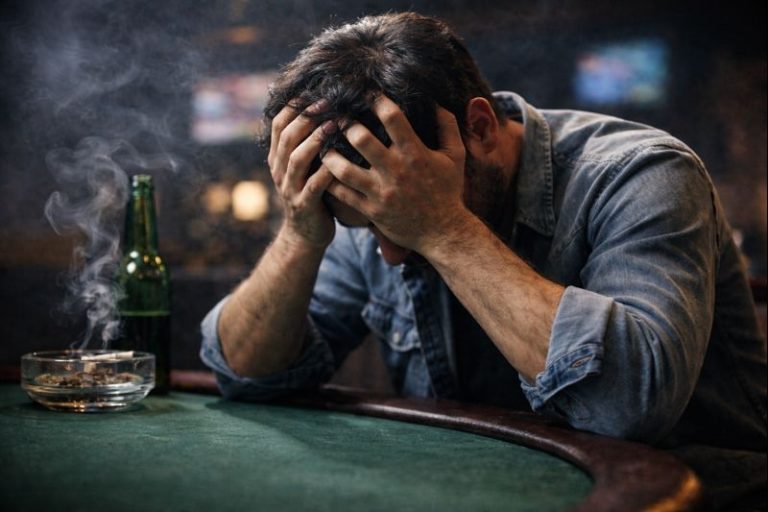
What Loss of Control Means
Simply put, loss of control is when you can’t consistently follow your own limits, even when you want to.
It’s not about being emotional or weak. It’s when your ability to stop just doesn’t work anymore.
People often picture problem gambling as someone being reckless from the start. But for many, it just happens more gradually. (Although some people start without clear boundaries, which makes drifting easier) For others, it’s about breaking their own rules. Limits exist only in theory, but pressure makes them easy to bend. One exception turns into two, then more. “Just this once” becomes a habit. Even if they set rules at first to keep it fun, those rules lose their power over time.
When control starts to slip, it can show up in three ways:
- Stop control: You can’t stop when you planned to.
- Money control: You start betting more than you meant to.
- Frequency control: What was once occasional becomes frequent, and soon it feels automatic.
That’s the main point. Loss of control isn’t just a label, it’s a pattern.
Related Articles: What is sportsbetting?
So Why Do People Think They’re Still in Control?
Here’s where it gets tricky. Your brain is really good at making up stories that sound totally reasonable in the moment. And being smart doesn’t protect you, actually, in contrast, smart gamblers often fall for this harder because they use mental shortcuts that make betting feel way safer than it actually is.
There are three big ones:
Illusion of control: “I’ve got this figured out.”
It’s that feeling where you think you can read the game now. Let’s take football as an example. You’ve watched the team for years. You know the manager’s style, you caught that tactical shift last week, or you study the data hard for a team you don’t know, and you see the pattern in the data, which you think your bet would be a sure win. And yeah, maybe your football brain and data learning skills are pretty decent. But here’s the thing: feeling informed starts to feel like being in control. Trust me, football doesn’t reward certainty. It’ll punish your confidence at the most random times.
The Gambler’s Fallacy (“It’s due”)
It’s thinking randomness has a memory. Like, “I’ve lost four in a row, so a win has to be coming.” But randomness doesn’t owe you anything. This belief keeps people going even when they planned to stop.
Near-miss effect: “I was so close.”
Say the game went exactly like you thought, but then you lost the bet on one random goal in the last minute. Feels like you almost won, right? Then you think, “Next time it’ll hit.” Your brain sees that near-miss as progress and pushes you to keep going. But in betting, a near-miss is just a pure loss.
Put all three together, you’ve got a dangerous mix: confidence that feels like control, patterns that feel “due,” and near-misses that feel like proof you’re onto something. That combination quietly pushes everything up, like how often you bet, how much you bet, and most importantly, it kills your ability to stop.
How “Fun” Turns Into Loss of Control
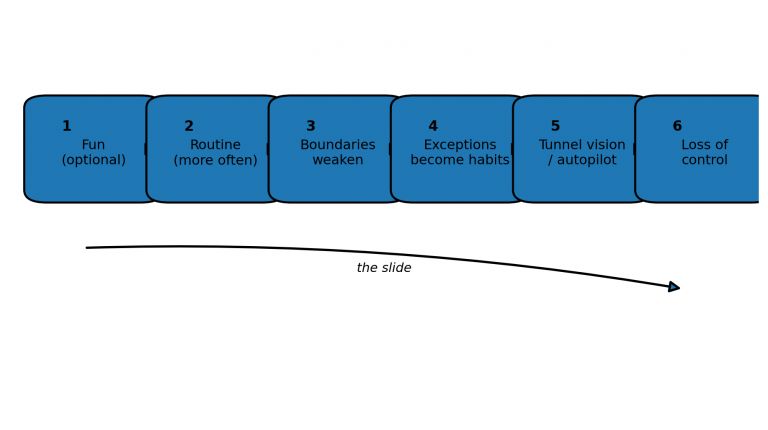
Most people don’t wake up and decide: Today I’m going to lose control. It’s usually a slide. And the slide often has recognizable stages.
Stage 1: Fun (optional)
Betting is small and totally optional. You can skip a match without even thinking about it. You stop whenever you want. Life is normal.
Stage 2: More often (routine begins)
It becomes part of your weekend or your midweek. Nothing dramatic. It just starts showing up more.
You can still honestly say “I’m just doing it for fun”, but the habit is starting to dig in.
Stage 3: Boundaries weaken (rules missing or fading)
Maybe you never had rules to start with, or the rules start getting blurry after some wins and losses. Limits get vague. “I’ll keep it small” starts meaning whatever you need it to mean that day.
This is usually when things get less conscious. Not reckless, just less on purpose.
Stage 4: Exceptions become habits
You start telling yourself, “Just this once.” You cross lines you used to respect. The rules are still technically there, but you are not really following them anymore.
Stage 5: Loss of control (the turning point)
The clearest sign isn’t a specific amount of money. It’s this: You keep going even when you’ve decided you should stop.
At that point, betting isn’t really a choice anymore. It’s pulling you more than you’re choosing it.
The "Tunnel Vision" State
In the later stages, people can feel like they are on “autopilot” or stuck in “tunnel vision.” Your focus narrows down to just the next bet, and your ability to step back or think long-term basically disappears. That’s why willpower doesn’t work in the moment, you’re not really thinking clearly. Then why stopping gets hard?
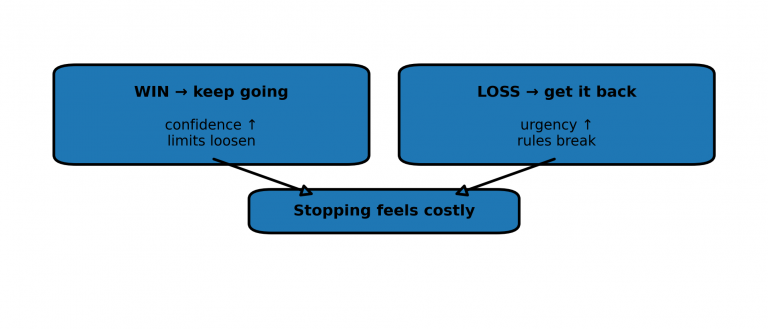
Once you are in that routine, two pressure loops make it really hard to stop:
After a Win: “I don’t want to stop now.” Excitement and confidence loosen your boundaries. You feel like you are on a hot streak. Stopping now feels like giving up momentum.
After a Loss: “I can’t stop like this.” This is the darker loop. Urgency and discomfort push you to break your rules. Stopping feels like accepting defeat. So you bet again, trying to “fix” that losing feeling.
Bottom line: wins loosen your limits, and losses pressure you to break them. Either way, stopping becomes emotionally expensive, and that is exactly when control is most fragile.
What It Leads To and How to Recognize It Early
Loss of control becomes costly quickly, not because every bet is big, but because the pattern spreads into other areas of life. Firstly, the financial fallout of borrowing, debt, touching money that was supposed to be saved, and then it comes to secrecy, hiding, minimizing, lying, not always out of malice, but often out of shame and panic. After that, there is relationship damage from arguments, broken trust, and isolation. Lastly, life functions are impacted by work slips, responsibilities get neglected, and stress becomes the background noise of daily life.
One important point: the consequences rarely stay private. Even when someone thinks they are “only hurting themselves,” the cost often spreads, and it can be too late when you find yourself in that place.
Given all we have discussed, how can we recognize the early signs of a loss of control?
If you want a clear way to spot the pattern early, it often shows up in three layers: thoughts, behaviors, and life function:
1) Thought patterns
- Thinking about betting more often, even when you are not betting.
- Mentally planning the next time constantly.
- Fixating on “getting even” or “solving” losses.
2) Behavior patterns
- Breaking limits more often.
- Chasing losses.
- Using money you originally would not touch.
- Hiding spending or activity.
3) Life-function impact
- Lateness, distraction, and missed tasks at work.
- Neglecting responsibilities to partner, kids, or family.
- Mood dominated by gambling-related stress.
None of these signs alone can diagnose someone. But together, they paint a clear picture.
A calm “pause & check” framing
This is not a list of techniques. It’s more of a reality check about what it sounds like when control is slipping.
If someone keeps hearing these internal lines more often, it’s usually a warning sign:
- “Just one more.”
- “I need it back.”
- “I can’t end like this.”
- “I’ll fix it with the next one.”
If there’s borrowing, repeated hiding, or real harm to work or home life, that’s usually a sign that outside support resources are worth taking seriously, not as drama, but as a practical safety net.
Conclusion
Again, the real risk of betting isn’t losing money.
It’s losing control.
Money is one consequence. The deeper issue is when betting stops being optional, when limits stop working, and stopping becomes harder than continuing.
Emotions matter mainly because they can speed up rule-breaking once control is already weakening. The danger isn’t having feelings. The danger is when those feelings start driving decisions you can’t reliably stop.
A quiet final line to keep in mind:
If you can’t stop, it’s no longer entertainment. When you see these early signs, pause and think about the people you love, and what your life could become. If you find it hard to stop, it’s worth looking at responsible professional support as a practical safety net.