
- The 7 Second Gap
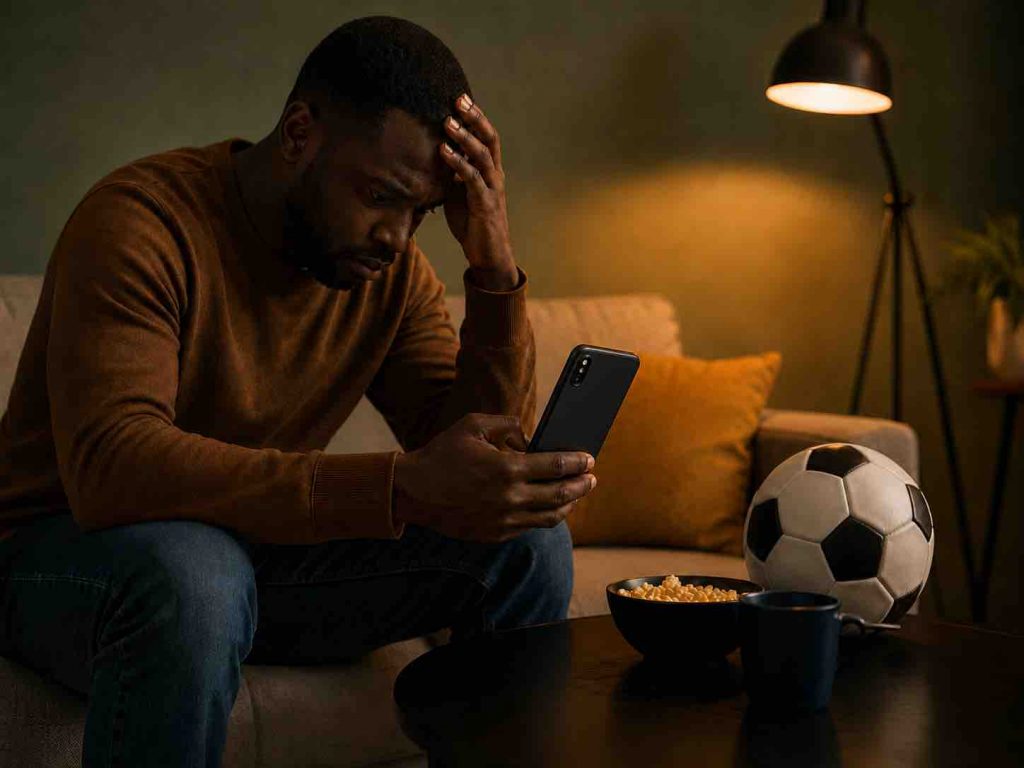
You’re watching a match. Something big happens: a penalty shout, a dangerous attack, or the referee points to the VAR screen. You open in-play, ready to tap, but the market is locked! Or the price has already moved somewhere you didn’t expect.
The reflex is instant: That’s unfair! Why does it always happen right when I’m about to click?
It feels personal because your brain is wired to treat what you see as “right now.” But here’s what’s actually happening: you’re watching one clock, while the market is using another. There isn’t just one “now” in live betting. There are three, and they don’t move together.
The Three Clocks Model: Event, Data, Broadcast
The easiest way to picture this is to imagine a friend at the stadium. They send you a voice note the moment a goal goes in. Meanwhile, your stream is still showing the build-up from a few seconds earlier. The keeper hasn’t dived yet, and the ball isn’t in the net. Although your friend isn’t psychic, they are just on a different clock.
Or picture a TV studio presenter still talking over footage from a moment that, for the data feed, is already ancient history.
Three separate clocks are running simultaneously:
Event clock: the exact second something happens on the pitch. A foul is given. A ball crosses the line. A player goes down.
Data clock: the second that event is captured, validated, and sent to the sportsbook’s pricing engine. This is where odds move.
Broadcast clock: the moment your screen actually shows you that event.
When | What happens |
T = 0s | The event happens (event clock) |
T = +1–2s | The data feed updates; the sportsbook starts recalculating (data clock) |
T = +1–3s | The market may lock, reprice, or reopen (pricing response) |
T = broadcast delay | Your screen shows you the moment (broadcast clock) — delay varies widely |
* T = broadcast delay
* T = 0 is the moment the event happens on the pitch. Everything else is measured from there.
That last row doesn’t have a fixed number, and that’s the point. Broadcast delay changes depending on how you’re watching. Traditional cable is usually a few seconds behind. Streaming platforms can lag even more, depending on the service, your connection, and network load at that moment. The range is real, and it changes all the time.
That unpredictability is exactly why the three clocks can’t reliably sync. If broadcast delay was always a clean, consistent gap, it would just be something you could expect. But it isn’t, so the distance between what you see and what the data already knows keeps changing.
Why Markets Get Locked: A System Pause, Not a Personal Block
When something important happens, a predictable chain starts inside the sportsbook: a trigger arrives, uncertainty spikes, the market suspends, the engine recalculates, and once the state is clearer, the market reopens.
That suspension is what you experience as a lock.
Think about what happens during a VAR review. Even commentators go quiet. They stop predicting and wait, because the state of the game is genuinely unresolved. The goal might stand, or it might not. The market does the same thing. Until the system gets a confirmed state, it refuses to price something it can’t price clearly.
If sportsbooks didn’t pause during those moments, the gap between the event clock, the data clock, and the broadcast clock would increase pricing risk. The system doesn’t want that risk, so it waits for clarity before reopening.
The pause means the system is choosing clarity over speed. It’s not watching your finger hover over the screen.
Why It Feels "Unfair": A Normal Human Reaction to Delayed Information
If your first reaction to a lock is a flash of frustration or a sense that the rules just changed on you, that’s not being oversensitive. Most people feel the same way. It’s worth understanding why, because once you see how it works, the feeling usually fades a bit.
The seeing-feels-now effect. When you watch something happen on screen, your brain treats it as “present.” It feels like it’s happening now, right in front of you. But really, you’re watching several seconds of the past. The moment you see is a recording of something the data already processed. That doesn’t feel natural. So when the market has moved and your screen hasn’t caught up, it feels like the rules changed mid-click. They didn’t. Your screen was just behind the game.
Selective memory and the weight of blocked moments. Your brain doesn’t remember routine moments as strongly as frustrating ones. Every time a lock happens at a big moment, that memory stands out. Every smooth interaction where the market was open and calm—and there are many more of those, gets remembered quietly. Over time, the pattern of “it always locks when I want to click” feels real and consistent, even if it actually happens much less often than it seems.
I’m not late because I’m slow. I’m late because my screen is behind the game.
A lock isn’t a message to me. It’s the market refusing to price uncertainty.
These aren’t excuses for the system. They’re just a more accurate description of what’s actually happening. Accurate explanations usually feel calmer than incomplete ones.
Related reading
- Why Odds Change Before Kickoff : How pre-match drivers differ from in-play speed
- How Sportsbooks Work : Why risk control exists and what it’s managing
- Betting Odds Explained: The 3 Common Misunderstandings — odds as prices, not predictions
- Learn more about Betting Odds