
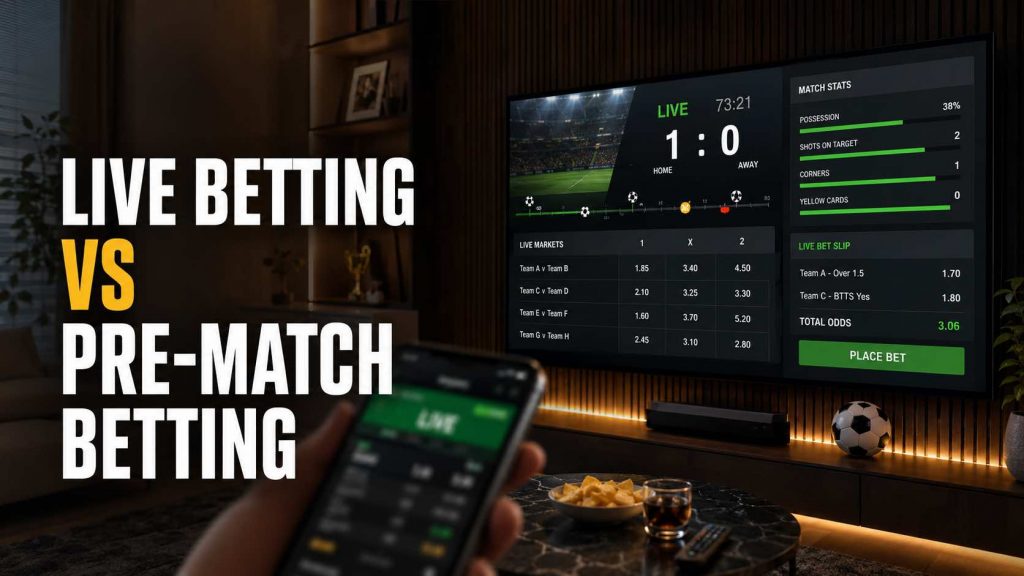
Odds move before kickoff. Odds move during the match. On the surface, it can look like the same thing: a number changing on a screen.
Under the hood, it isn’t.
Pre-match pricing and live (in-play) pricing work in different ways. They update for different reasons, at different speeds, and use different information. Because the environment changes, the player’s experience changes too, especially in how much and how quickly you need to process information.
This article isn’t about deciding which is better. Instead, it explains what kind of pricing environment you’re entering and what it asks of your attention, time, and understanding.
A shared starting point: both are pricing uncertainty
Before splitting them apart, it’s worth naming what they have in common.
Odds, whether pre-match or live, are prices set under uncertainty. They let a sportsbook show the chance of an outcome, add a margin, and manage money coming from different sides. When new information appears, the prices change. This is true for both systems.
Both systems face the same basic challenges: how new information affects pricing, how the book manages its risks, and how the market stays sustainable. This means the market must remain quotable, updatable, and able to settle bets smoothly.
The main difference is in how quickly and often these problems are solved. This change in pace is what makes the two experiences feel so different.
The Setup: Pre-match pricing
Pre-match pricing is similar to a seafood stall at a morning market. The fisherman brings in the day’s catch, and the vendor sets an opening price based on what’s available and what buyers might want. The price isn’t fixed. If people hear there’s not much fish, the price goes up. If buyers rush in and the best items sell quickly, the price changes again. It doesn’t change every few seconds; it only moves when something important shifts the balance between supply and demand.
That’s roughly how pre-match pricing tends to work. There’s an initial line. Then it moves as the information landscape shifts.
What tends to move it
A few things typically drive pre-match price movement. Injury news is a big one : a key player ruled out can reprice a match quickly. Another is confirmed team sheets arriving closer to kickoff. Weather in some sports. Broader market shifts, where prices at one major book influence what others show. And demand itself: if a lot of money comes in on one side, that tends to shift the line regardless of what the news says.
(For a fuller breakdown of what drives pre-match movement, see “Top 5 Drivers That Changed the Odds Before Kickoff.”)
What it feels like from your end
For users, this usually means a pace that’s easy to follow. Prices update in clear steps: a lineup is announced, prices change; a news story breaks, prices change. Between these events, things often stay stable.
The observation window is longer. If you’re watching a line move pre-match, you usually have enough time to actually think about what you’re seeing before it changes again. That’s not nothing.
The Chase: Live / In-play pricing
Live pricing works differently. Instead of updating based on pre-match news, it keeps changing as the match unfolds. The game is always shifting with goals, near-misses, red cards, and changes in possession, so the model must keep up almost in real time.
This leads to a user experience with faster changes, bigger jumps, and markets that sometimes disappear and come back. The screen can feel almost restless.
What triggers re-pricing
Three things tend to drive live re-pricing.
The main triggers are specific events like goals, red cards, VAR decisions, major injuries, and substitutions. These events change the state of the game. For example, after a red card, the game is truly different, and prices update to show that.
There are also time effects. In some markets, the passage of time changes the odds. For example, a team defending a one-goal lead at 85 minutes is in a different situation than at 50 minutes, even if nothing else has changed. Some models update partly based on the clock.
Sometimes, the model struggles to price things clearly, such as during a VAR check, when a player is injured and the severity is unclear, or when a goal is not yet confirmed. In these moments, some markets may pause briefly. This isn’t a system failure; it’s the system being careful during real uncertainty.
How it actually feels to watch
For users, this means information comes much faster and in greater amounts. Updates happen more often, jumps can be bigger, and whether a market is available can change quickly in ways that pre-match markets do not.
(For a deeper look at how live environments behave in practice, see “Why You Are Always Too Late for Live Betting?”)
Why Live game takes more out of you?
This is the part that probably matters most for anyone trying to make sense of what they’re looking at.
Low-frequency vs. high-frequency input
Pre-match tends to feel like lower-frequency input. You get a signal, a lineup news update, a line movement, you process it, you decide what it means. There’s usually some space between signals.
Live betting feels like information is coming at you much faster. Events happen, prices update, and then something else happens right away. The interface might change again before you’ve even processed the last update. This is more demanding on your mind.
It’s not that each piece of information is harder to understand, but there’s more of it, coming quickly, and it doesn’t wait for you.
You're always a step behind
It’s also important to mention the timing of updates. The pricing model behind a live interface gets automated data, like goals, red cards, and time updates, and changes prices almost instantly. The information you receive, whether from a video stream, text commentary, or notifications, might not be perfectly in sync with the model.
This isn’t a trick by sportsbooks. It’s simply how the two systems work. The timing of model updates and the timing of user information are not the same. This means the time you have to react—the gap between learning something and the price changing—can be very short. It’s not because anyone is hiding anything, but because the system is fast.
It never really lets you switch off
One thing that doesn’t get discussed much: pre-match and live have different emotional rhythms, which affects how tiring each is to engage with.
With pre-match betting, emotions usually peak when you make a decision and then settle into a waiting period. There’s a natural pause. Live betting is more constant: events, interface updates, and price jumps all trigger reactions. These triggers keep coming as long as the match continues. It might not seem important, but over a full game, it can be tiring.
Feeling close to the action isn't an edge
Live betting can feel more interactive because you see the match change in real time as prices update. This interactivity is real; you are part of a more dynamic environment.
However, this doesn’t automatically give you an advantage. The interactivity can make you feel more involved and closer to the action, but being interactive doesn’t mean the environment is more predictable. In fact, a faster-moving environment can often be harder to read.
Live offers higher participation. Not guaranteed superiority.
Different game, different demands
None of this is meant to suggest pre-match is “better” or live is “worse.” Both exist because they serve different purposes for what people want to do.
The point is that these are truly different environments with different demands. Pre-match betting is like reading a stable set of signals with more time to think. Live betting is like following a fast-moving, constantly changing stream with less time to process and a more continuous emotional pace.
Choosing between the two is not just a small style choice. It changes how you think and feel during the experience in a big way.
Summary
Pre-match pricing resembles a market-style quoting environment shaped by discrete information updates and exposure management. In-play pricing resembles real-time state re-pricing, shaped by events, time effects, and the continuous flow of match data.
For players, live betting usually means you have to interpret more information. Updates come more often, you have less time to react, and the sense of interactivity can sometimes be confused with predictability.
Knowing which system you’re dealing with doesn’t change the odds, but it can help you better understand the environment you’re in.
Related reads: