
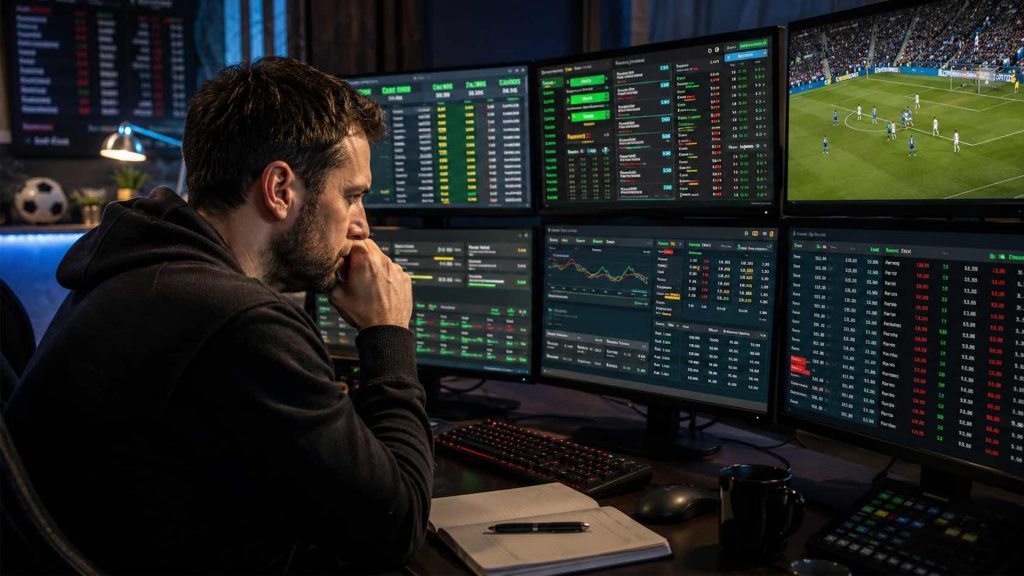
There are two ways to experience a football match.
The first way is the one most people know. You watch the story unfold: the goal, the comeback, the red card that changes everything. You follow the score, feel the momentum shift, and share your certainty with friends before the referee’s whistle confirms it.
The second way is quieter and almost invisible. A sportsbook does not watch the match the same way you do. It treats the match as a workflow.
Fans focus on outcomes. Sportsbooks follow a process: price, risk, handling uncertainty, and settlement. ( If you like to know how sportsbooks work in general, read Sports Betting 101: How Sportsbooks Work.
This article shows you one match from two perspectives, step by step, from when the opening odds go live to when a payout is processed. It will not tell you how to bet better. Instead, it explains why the two screens rarely match up, and why that gap causes confusion.
The Two Screens
When you open a betting app during a match, you are looking at a screen built for one purpose. On the other hand, the sportsbook is looking at a completely different one.
The fan screen tracks:
- Score, time, and momentum.
- “What should happen” narratives — form, quality, history.
- Emotional certainty, amplified by social chat that moves faster than verified facts
The sportsbook screen tracks:
- Price as a business input, not a verdict.
- Liability and exposure: where money has concentrated and where risk is distributed.
- Market status: is this market open, suspended, or reopened?
- Verification state: Is the event confirmed, or still under review?
- Settlement triggers: the specific rules that determine what counts and what doesn’t.
Withe said above. One is watching a story. The other is managing a pipeline.
Sportsbook's Match Operations Pipeline: From Opening Odds to Settlement
What follows is that pipeline — the full process a sportsbook runs across a single match. At each stage, the gap between the two screens either opens wider or snaps shut.
Step 1: Opening Price — Kickoff Hasn't Happened Yet
You watch: “Does this look right?” You compare the opening odds to your sense of which team is stronger, better-rested, or playing at home. If the number matches your view, it confirms something. If it doesn’t, you wonder whether you’ve spotted something the market missed.
Sportsbook sees a starting point. Opening odds are the first step in a pricing process, set up to attract balanced bets rather than pick a winner. Analysts, models, and early market data all help create that first number.
The difference that matters: Opening odds are the start of a pricing process.
Step 2: Money Arrives — Exposure Forms
You watch: Opinions arriving everywhere. Social media is filling up with takes. Group chats reach consensus fast. Narratives form and harden in real time.
Sportsbooks focus on where liability is building up. As bets come in, the sportsbook does not judge if the opinions are right. It watches where the money goes, which outcomes are getting the most bets, whether risk is becoming one-sided, and how the book looks across all outcomes.
The difference that matters: Sportbooks are not grading opinions. They’re managing exposure.
Step 3: Pre-Match Adjustments — Repricing Before Kickoff
You watch: Odds moving. In betting culture, movement carries meaning , the market is telling you something. A line shift feels like intelligence leaking through.
Sportsbooks look at a mix of signals. An odds change might mean exposure needs to be balanced, a sharp bet has triggered a review, new injury news or late team selection has come in, or the sportsbook is matching the wider market to avoid arbitrage. Any of these reasons can move a line.
The difference that matters: A move can be about risk management for a sportsbook, not the truth.
(For a full breakdown of what drives odds movement before kickoff, see Top 5 Drivers That Changed the Odds Before Kickoff.)
Step 4: Kickoff and the In-Play Engine — Event-Driven Updates
You watch: A continuous narrative. One moment flows into the next. The match feels like a single, connected story with rhythm, momentum, and turning points.
They see separate events coming in as structured data: a goal, a card, a substitution, or an injury. Each event triggers software that recalculates prices and risk based on set inputs. For the in-play engine, the match is not a story but a stream of events, each one updating the model’s view of the game.
Time works differently here. Every minute without a goal changes the implied chances of each outcome. The clock itself is a constant input for pricing.
The difference that matters: In-play is less a story and more a stream of events.
Step 5: Suspension — Locking as a Safety Firewall
You see the market go dark just when you want to act. A goal is scored, VAR is called, and suddenly the market is locked. It can feel deliberate, even unfriendly, like a door closing at the worst moment.
Sportsbooks see a spike in uncertainty. VAR reviews, disputed moments, unconfirmed injuries, and technical issues all mean the current price might be based on incomplete or wrong information. Suspension is not a judgment about you. It is a safety step that keeps pricing steady until things are clear.
The difference that matters: Locking isn’t a message. It’s a safety response for sportsbooks
Step 6: Settlement — Triggers, Boundaries, and Verified Records
You watch: What happened on your television. The ball crossed the line. The match ended in the 94th minute. The referee pointed to the spot. You saw it. It was unambiguous.
Sportbooks look at rule triggers, scope boundaries, and a verified event record. Settlement does not follow the television broadcast. It follows the rules for each market: when it starts, when it ends, what counts as a valid event, and what the official record says after the match.
A goal given on broadcast but then disallowed by VAR is not a settled outcome. A match that goes to extra time may fall outside the scope of a “90-minute” market. A disputed moment may require post-match verification before any market is settled.
The difference that matters: Sportsbooks settle markets, not feelings.
(For a full explanation of how settlement works, including scope and trigger definitions, see our settlement guide: Reading a Bet Slip? Here’s What You Need to Know)
Step 7: Review and Resettle — Verification and Correction
You watch: A result that seemed final, changed. Something in your account that looked settled is now different. It sometimes can feels wrong , arbitrary, even suspicious.
Sportsbooks follow a validation process that continues after the match ends. Official data feeds are checked. Disputed events are reviewed with verified sources. Errors, whether in automation or data, are corrected. If a market was settled with incomplete information, it is resettled based on the verified record.
The difference that matters: Most “weird” moments come from verification, not manipulation.
How Sportsbook Run Thousands of Matches at Once
Across a busy weekend of football, a major sportsbook is running hundreds of matches simultaneously. No human team watches every event in real time.
Sportsbooks don’t watch matches. They listen to structured event feeds.
Data providers, which are specialist companies working in stadiums and data centers, turn live match events into structured streams. A goal is not reported by a person; it is a coded data packet that arrives in milliseconds and triggers automated responses for pricing, risk, and market status.
Event-driven automation handles the routine work: pricing updates after each event, risk controls that flag exposure thresholds, market status changes as conditions warrant, and settlement verification once official data is confirmed.
Human traders and risk managers handle exceptions, such as ambiguous moments, high-profile matches, and unusual cases that automation cannot handle. They do not watch every match. They focus on situations the system marks as needing human judgment.
Does Sportsbooks Lose Money? (And How They Prevent It)
Sportsbooks are not infallible. There are specific conditions under which they take losses, and specific systems designed to prevent each one.
Where losses happen:
Unmanaged exposure happens when liability builds up on one outcome and the market moves against the book. Mispricing or bad inputs occur when the opening line or in-play model is wrong and sharp bettors spot it first. Correlation risk is when outcomes across several markets move together in ways that were not priced in. Operational and settlement errors are mistakes in automation or data that need costly corrections. Fraud and payment risk involve bad-faith activity at the account or payment level. Promotional cost overruns happen when bonus offers cost more than expected because outcomes cluster in ways that are not favorable.
How they prevent it:
Repricing means adjusting prices as new exposure information comes in. Limits and risk controls restrict bet sizes on accounts or markets that carry higher risk. Suspension stops markets during times of uncertainty. Correlation management involves pricing related markets to account for linked outcomes. Verification workflows confirm event records before settling. Identity and payment controls help reduce fraud and protect against bad-faith activity at the account level.
None of this is visible during a match. It runs in the background, as infrastructure.
Conclusion
A sportsbook runs a workflow. Fans watch a story.
Neither of these approaches is wrong. They are simply different screens showing different information, and most frustration in sports betting comes from thinking they are the same.
Now that you can see both, the gap should feel smaller. The locked market makes more sense. The resettlement makes more sense. The odds move that seemed significant makes more sense.
More clarity. Less urgency.
If you want to go deeper on the fundamentals, start at our betting basics hub